
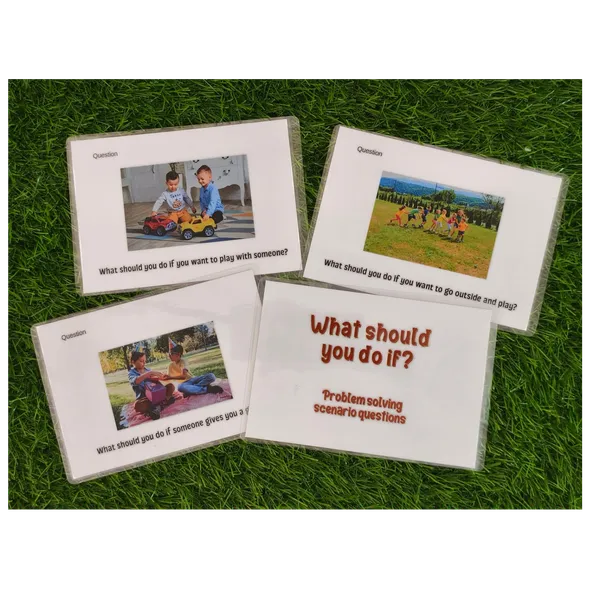


What Should You Do Problem Solving Task Cards Set Of 19
₹499
₹900
44% OffFinal Price inclusive of all taxes
Cash on Delivery
Free Delivery
Get it delivered in 3-6 days
size
11*16 cm
Product Information
Brand
Speechmart
Ideal For
Kids, Toddlers, Children With Autism, ADHD, Speech Delay, Speech Therapy Patients, Special Needs Students, Early Learners, Preschoolers, Middle Schoolers
Material
Premium Thick Paper, Waterproof Pouch Laminated
Country of Origin
India
Pack of
19
Product Type
Flash Card
Product Description
A child can be highly verbal, but still freeze, shut down, or make unsafe choices when faced with a sudden, real-world problem. Navigating unexpected situations—like spilling a glass of milk, getting lost in a store, or scraping a knee—requires a complex cognitive-linguistic skill set: analyzing the problem, predicting a consequence, and formulating a safe, logical solution.
The "What Should You Do If?" Flashcard Set is a premium, highly targeted tool designed to build this exact layer of executive control. Featuring 19 deeply practical situational cards, this set moves away from abstract academic drills and focuses entirely on the safety, social, and functional challenges a child encounters in everyday life.
How the Smart Front-to-Back Layout Works:
• The Front (The Challenge): Displays a large, clear 4x6 inch visual prompt and situational question that introduces a common real-world obstacle (e.g., "What should you do if you lose your pencil?" or "What should you do if you smell smoke?").
• The Back (The Blueprint): Features the structured target answer key, logical reasoning points, and conversational prompts. This keeps the instructor's eyes completely free for observation and data tracking, while providing a clear guide to shape the child's response.
Why Speech Therapists, Special Educators, & BCBAs Value This Set:
• Targets Core Executive Functioning: Directly aligns with IEP goals focused on situational problem solving, predictive verbal reasoning, cause-and-effect mapping, and functional pragmatics.
• Essential for Neurodivergent Learners: Children with Autism Spectrum Disorder (ASD), ADHD, or intellectual disabilities often struggle with cognitive flexibility. These cards break down abstract safety rules into highly predictable, manageable scripts.
• Massive 4x6 Inch Form Factor: The extra-large layout provides exceptional visual clarity, making the cards highly engaging across a busy therapy desk or during small-group classroom discussions.
Why Parents Love It:
• Bridges the Gap to True Independence: Practicing these 19 everyday scenarios gives your child a mental blueprint for safety, significantly reducing their anxiety and helping them handle daily mishaps confidently when you aren't by their side.
• Encourages Deep Conversational Flow: These are not simple "yes or no" cards. Each scenario acts as a natural springboard for meaningful back-and-forth communication, teaching your child how to articulate their logical thoughts.
• Indestructible Clinical Build Quality: Toddler-proof, spill-proof, and completely tear-proof. Every single card features premium pouch lamination with sealed, rounded safety corners. They easily survive travel bags, messy kitchen counters, and can be effortlessly wiped clean after use.
Product Specifications:
• Total Content: 19 Premium Double-Sided Problem-Solving Cards.
• Card Dimensions: Large 4 × 6 Inches (Extra-large format—optimal for professional clinic presentation and clear visual tracking).
• Finish: High-Grade Premium Pouch Laminated (100% waterproof, drool-proof, ultra-rigid, and scratch-resistant).
• Target Skills: Situational Problem Solving, Verbal Reasoning, Cause & Effect, Functional Pragmatics, Safety Awareness, and Executive Control.
• Best Suited For: Early intervention, preschool, and school-age language development, as well as individuals with Autism Spectrum Disorder (ASD), ADHD, Learning Disabilities, or global developmental delays.
The "What Should You Do If?" Flashcard Set is a premium, highly targeted tool designed to build this exact layer of executive control. Featuring 19 deeply practical situational cards, this set moves away from abstract academic drills and focuses entirely on the safety, social, and functional challenges a child encounters in everyday life.
How the Smart Front-to-Back Layout Works:
• The Front (The Challenge): Displays a large, clear 4x6 inch visual prompt and situational question that introduces a common real-world obstacle (e.g., "What should you do if you lose your pencil?" or "What should you do if you smell smoke?").
• The Back (The Blueprint): Features the structured target answer key, logical reasoning points, and conversational prompts. This keeps the instructor's eyes completely free for observation and data tracking, while providing a clear guide to shape the child's response.
Why Speech Therapists, Special Educators, & BCBAs Value This Set:
• Targets Core Executive Functioning: Directly aligns with IEP goals focused on situational problem solving, predictive verbal reasoning, cause-and-effect mapping, and functional pragmatics.
• Essential for Neurodivergent Learners: Children with Autism Spectrum Disorder (ASD), ADHD, or intellectual disabilities often struggle with cognitive flexibility. These cards break down abstract safety rules into highly predictable, manageable scripts.
• Massive 4x6 Inch Form Factor: The extra-large layout provides exceptional visual clarity, making the cards highly engaging across a busy therapy desk or during small-group classroom discussions.
Why Parents Love It:
• Bridges the Gap to True Independence: Practicing these 19 everyday scenarios gives your child a mental blueprint for safety, significantly reducing their anxiety and helping them handle daily mishaps confidently when you aren't by their side.
• Encourages Deep Conversational Flow: These are not simple "yes or no" cards. Each scenario acts as a natural springboard for meaningful back-and-forth communication, teaching your child how to articulate their logical thoughts.
• Indestructible Clinical Build Quality: Toddler-proof, spill-proof, and completely tear-proof. Every single card features premium pouch lamination with sealed, rounded safety corners. They easily survive travel bags, messy kitchen counters, and can be effortlessly wiped clean after use.
Product Specifications:
• Total Content: 19 Premium Double-Sided Problem-Solving Cards.
• Card Dimensions: Large 4 × 6 Inches (Extra-large format—optimal for professional clinic presentation and clear visual tracking).
• Finish: High-Grade Premium Pouch Laminated (100% waterproof, drool-proof, ultra-rigid, and scratch-resistant).
• Target Skills: Situational Problem Solving, Verbal Reasoning, Cause & Effect, Functional Pragmatics, Safety Awareness, and Executive Control.
• Best Suited For: Early intervention, preschool, and school-age language development, as well as individuals with Autism Spectrum Disorder (ASD), ADHD, Learning Disabilities, or global developmental delays.